
Dedicated Object Detection Product Teams
Oodles builds enterprise-grade Object Detection software by combining computer vision engineers, deep learning specialists, and MLOps experts. Our teams design scalable detection systems using YOLO, Faster R-CNN, SSD, EfficientDet, OpenCV, PyTorch, and TensorFlow to deliver accurate object localization, classification, and multi-object tracking across cloud and edge environments.
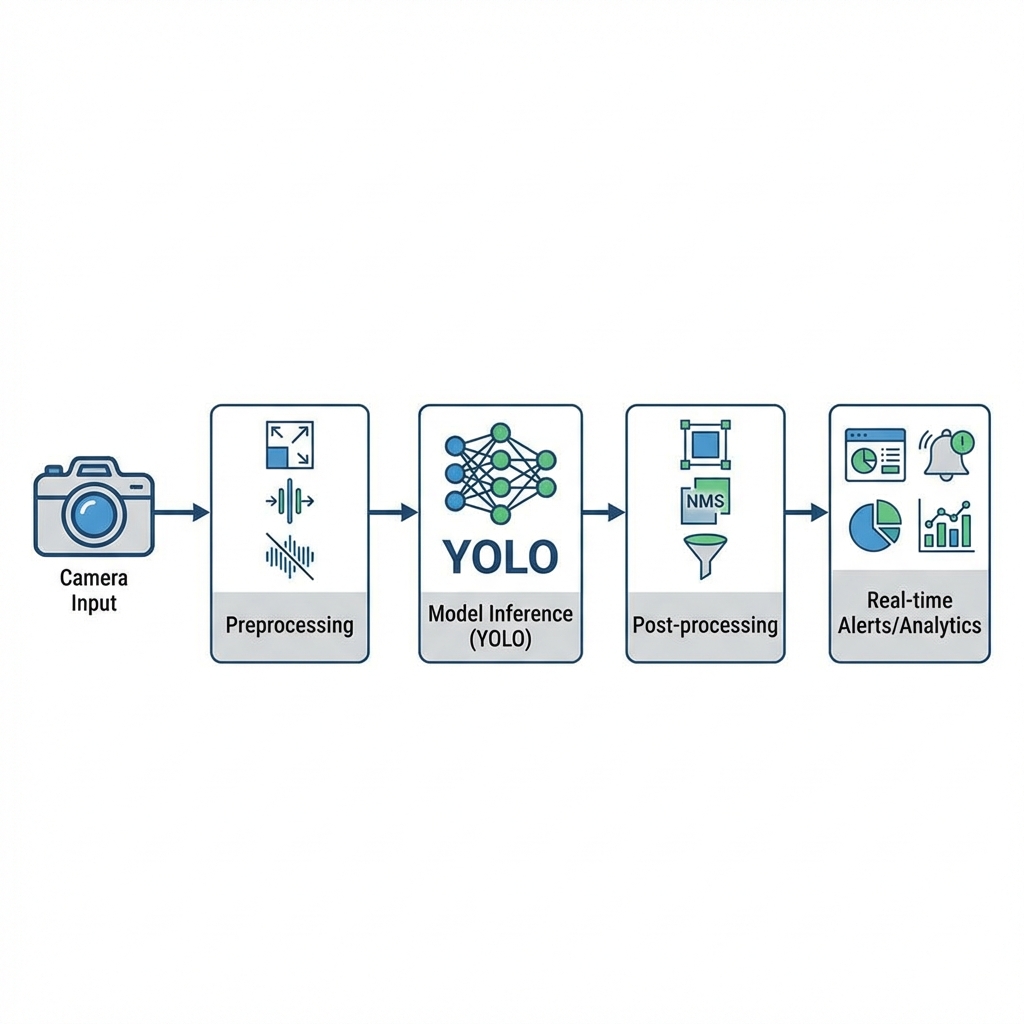
How We Build Object Detection Systems
Our Object Detection development process starts with defining object classes, accuracy targets, frame-rate requirements, and deployment constraints. We design end-to-end detection pipelines including image preprocessing, model selection (YOLO, R-CNN, SSD), dataset preparation, training and fine-tuning, evaluation, and MLOps-driven deployment for cloud, edge, and embedded devices.
Object Detection Modules We Engineer
Data Collection & Annotation
High-quality dataset creation using bounding boxes and class labels to train robust Object Detection models.
Detection Models & Architectures
Implementation of YOLOv8, Faster R-CNN, SSD, and EfficientDet models optimized for speed, accuracy, and deployment targets.
Active Learning Workbenches
Continuous improvement workflows where low-confidence detections are reviewed and reintroduced into training cycles.
Performance & Bias Monitoring
Real-time tracking of precision, recall, mAP, latency, and data drift to maintain reliable Object Detection performance.
Real-Time Inference Layer
Low-latency inference using GPU acceleration or edge devices such as NVIDIA Jetson and Google Coral.
Deployment & MLOps Automation
CI/CD-driven training, versioning, and rollout of Object Detection models using Docker, Kubernetes, and monitoring pipelines.
Object Detection Solution Blueprints
Prebuilt Object Detection workflows combine video ingestion, real-time detection, object tracking, and alert generation to automate visual monitoring and decision-making.
Security & Surveillance
Real-time detection of people, vehicles, and intrusions with automated alerts.
Retail Analytics
Detect customers, shelves, and products to enable footfall analysis, planogram compliance, and loss prevention.
Autonomous Systems & ADAS
Detection of pedestrians, vehicles, traffic signs, and obstacles for autonomous navigation.
Industrial Quality Control
Visual inspection systems that detect defects, missing parts, and assembly issues on production lines.
Logistics & Inventory
Automated detection and counting of packages, pallets, and assets in warehouses.
Workplace Safety (HSE)
Object Detection for PPE compliance, hazard recognition, and unsafe activity alerts.
FAQs (Frequently Asked Questions)
AI object detection uses deep learning models such as YOLO, Faster R-CNN, and SSD to identify, classify, and localize multiple objects within images and video streams in real time.
Object detection software development leverages TensorFlow, PyTorch, OpenCV, annotated datasets, pretrained CNN models, and GPU acceleration to build scalable AI vision systems.
Custom object detection models are trained using domain-specific labeled datasets, transfer learning, data augmentation, hyperparameter tuning, and validation pipelines to ensure high detection accuracy.
Object detection solutions integrate via REST APIs, cloud platforms, or edge devices to automate surveillance, quality inspection, retail analytics, logistics monitoring, and industrial automation.
Yes, optimized object detection pipelines use GPU inference engines, model compression, and edge computing to deliver low-latency, real-time video analytics and automated alerts.
Accuracy is maintained through continuous performance monitoring, drift detection, retraining with new datasets, and automated validation workflows to ensure reliable object detection results.
Need a dedicated team for Object Detection Software Development? Let's talk







We are ISO 9001:2015 Certified
Connect with us


Follow us