
AI Image Classification Development Services
Oodles delivers enterprise-grade AI Image Classification solutions using Python-based computer vision frameworks. Our engineers leverage deep learning models such as CNNs and Vision Transformers to accurately classify images across industries. From data preparation to scalable deployment, we build high-performance image recognition systems optimized for accuracy, speed, and reliability.
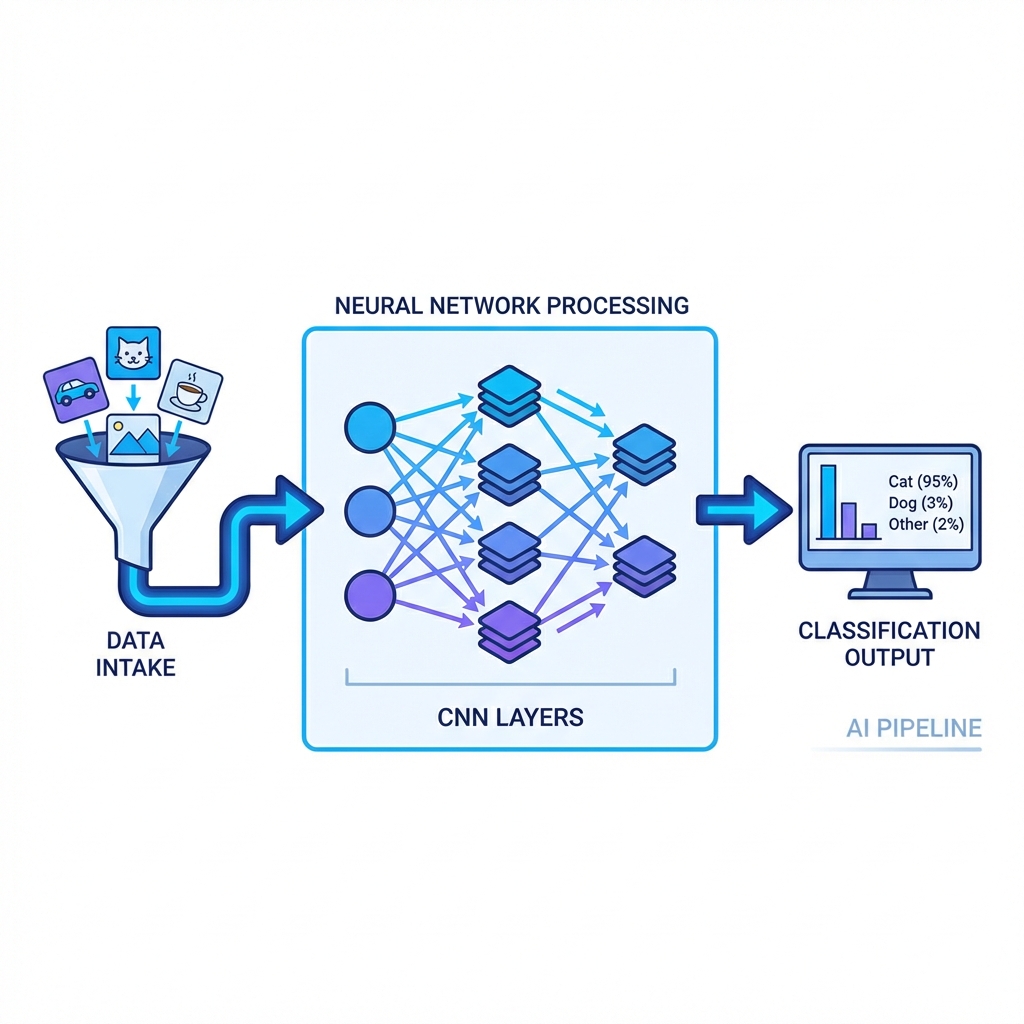
AI Image Classification Development Workflow
Our image classification pipeline starts with understanding your visual datasets and class taxonomy. We design and train deep learning models using Python frameworks such as TensorFlow and PyTorch, combined with OpenCV for image preprocessing. Each model is evaluated for accuracy, latency, and bias before being deployed as a scalable AI image recognition solution.
Image Classification Technology Stack
Data Collection & Annotation
Image datasets are collected from cameras, mobile devices, and enterprise systems. Annotation tools such as LabelImg and CVAT are used to generate high-quality labeled data essential for training accurate image classification models.
Model Development (Python)
AI image classification models are developed using Python with deep learning frameworks such as TensorFlow, PyTorch, and Keras. Architectures like ResNet, EfficientNet, and Vision Transformers (ViT) are trained to achieve high classification accuracy.
Image Processing & Augmentation
Libraries such as OpenCV, Pillow, and Albumentations are used for image preprocessing, normalization, and augmentation. These techniques improve model generalization across varying lighting, angles, and image quality.
Model Evaluation & Optimization
Models are evaluated using metrics such as accuracy, precision, recall, and F1-score. Performance optimization techniques like quantization and pruning ensure efficient image classification inference.
API & Edge Deployment
Image classification models are deployed using FastAPI or Flask as REST APIs. For real-time use cases, models are optimized with TensorRT, ONNX, or TFLite for edge and embedded devices.
MLOps & Monitoring
CI/CD pipelines, Docker, Kubernetes, and model monitoring tools are used to manage the complete lifecycle of AI image classification systems, ensuring scalability, version control, and consistent performance in production.
Image Classification Use Cases
Oodles delivers tailored image classification solutions—from automated quality control and medical diagnostics to visual search and content moderation—helping organizations extract actionable insights from visual data.
Retail & E-commerce
Enable visual search, automated product tagging, and inventory management by classifying product images with high precision.
Medical Imaging & Diagnostics
Assist radiologists by classifying X-rays, MRIs, and CT scans to detect abnormalities and support early disease diagnosis with explainable AI models.
Manufacturing & Quality Assessment
Automate defect detection on assembly lines by classifying parts as healthy or defective effectively reducing waste and ensuring product quality.
Public Security & Surveillance
Enhance safety with real-time anomaly detection, intrusion alerts, and crowd monitoring by classifying events in video feeds.
Automotive & Transportation
Support ADAS and autonomous driving with traffic sign recognition, pothole detection, and vehicle classification.
Digital Media & Moderation
Automatically categorize user-generated content and filter unsafe images to scalable content moderation workflows.
FAQs (Frequently Asked Questions)
AI image classification uses deep learning models such as Convolutional Neural Networks (CNNs) and Vision Transformers to analyze visual features and automatically assign accurate category labels to images.
AI image classification development uses TensorFlow, PyTorch, OpenCV, transfer learning, data augmentation, and GPU acceleration to build high-performance and scalable visual recognition models.
An AI image classification model is trained using labeled image datasets, transfer learning techniques, hyperparameter tuning, and validation testing to maximize prediction accuracy and reduce bias.
AI image classification solutions integrate via REST APIs, cloud services, or edge deployments to automate visual inspection, product recognition, medical analysis, and intelligent decision-making.
Yes, optimized AI image classification systems use GPU acceleration, model compression, and low-latency inference engines to enable real-time image recognition in surveillance and automation systems.
Accuracy is maintained through continuous model monitoring, performance analytics, drift detection, retraining with new data, and optimization techniques to ensure consistent classification performance.
AI image classification improves operational efficiency, reduces manual inspection costs, enhances product discovery, strengthens quality control, and enables scalable AI-driven automation across industries.
Need a dedicated team for AI Image Classification Development? Let's talk







We are ISO 9001:2015 Certified
Connect with us


Follow us