
Cost-Efficient LLM Fine-Tuning with QLoRA
Oodles helps enterprises fine-tune large language models using QLoRA (Quantized Low-Rank Adaptation)—a memory-efficient fine-tuning approach that combines low-rank adapters with 4-bit and 8-bit quantization to dramatically reduce GPU costs without sacrificing model quality. Our QLoRA pipelines are built on PyTorch, Hugging Face Transformers, PEFT, bitsandbytes, CUDA, FlashAttention, and gradient checkpointing, enabling stable fine-tuning of billion-parameter models on commodity GPUs and cloud instances.
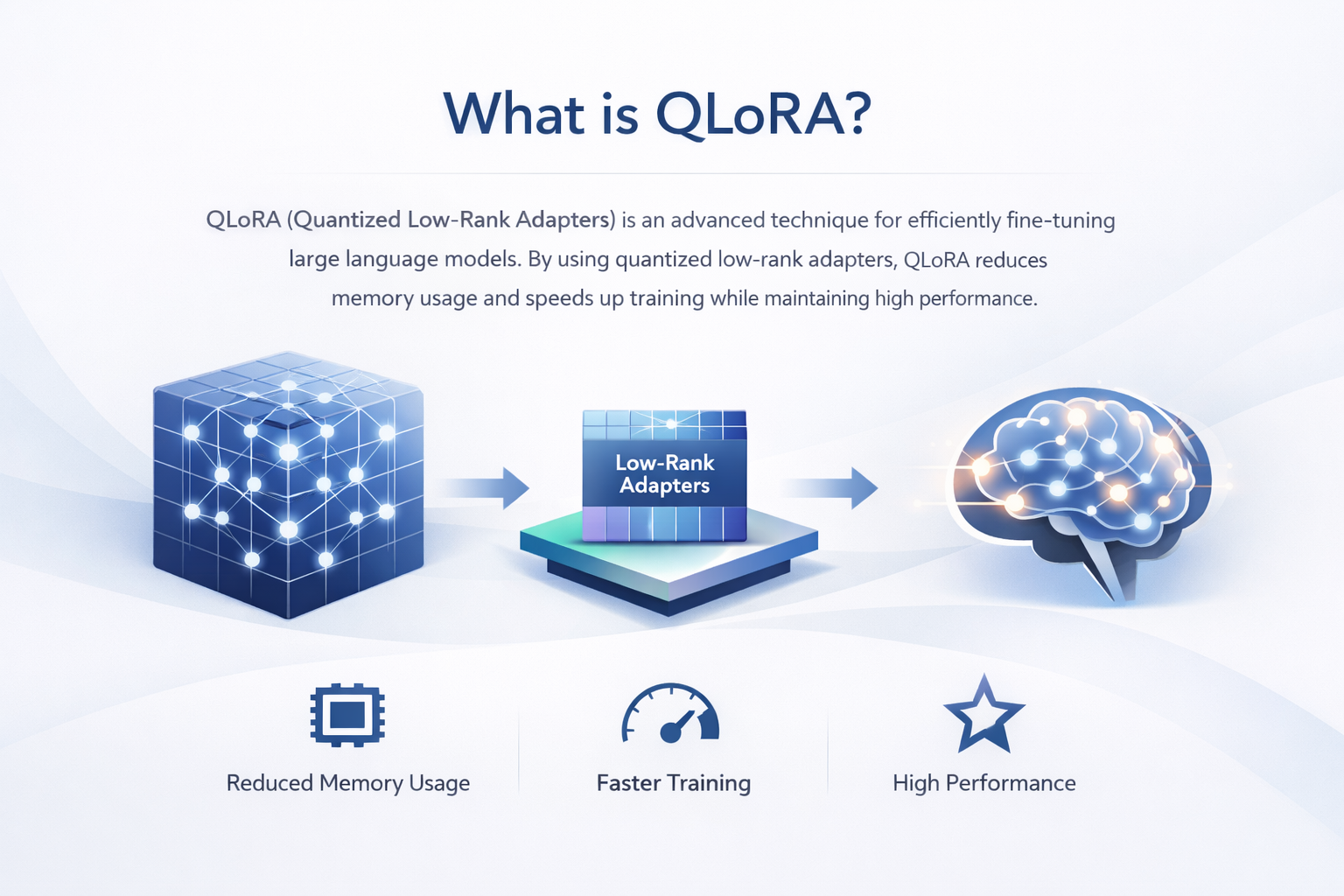
What is QLoRA?
QLoRA (Quantized Low-Rank Adaptation) is a parameter-efficient fine-tuning technique that enables large language models to be fine-tuned using 4-bit or 8-bit quantized base weights combined with trainable low-rank adapters.
At Oodles, QLoRA is implemented using PyTorch, Hugging Face Transformers, PEFT, and bitsandbytes, allowing memory-efficient training while preserving full model expressiveness and downstream task performance.
Why Choose Oodles for QLoRA Fine-Tuning?
- ✓ 4-bit / 8-bit quantization with bitsandbytes to reduce GPU memory by up to 80%
- ✓ Adapter-based training using QLoRA, LoRA, and DoRA via PEFT
- ✓ FlashAttention, paged optimizers, and gradient checkpointing for stability
- ✓ Integrated evaluation for safety, hallucination, toxicity, and PII leakage
- ✓ Adapter checkpoints and merged weights ready for vLLM, TGI, or cloud inference
GPU-Light
4-bit/8-bit quantized fine-tuning
Adapter-First
LoRA / QLoRA / DoRA
Reliable
Evaluations & guardrails
Deployable
vLLM / TGI ready
How Our QLoRA Delivery Process Works
A structured path from data readiness to tuned, guardrailed, and deployable LLMs optimized with QLoRA.
1
Discovery & Task Design: Clarify objectives, latency/throughput targets, compliance needs; select base model and adapter plan.
2
Data Prep & Guardrails: Curate datasets, apply PII/NSFW filters, dedupe, balance, and design eval splits with toxicity, hallucination, and jailbreak probes.
3
Training Plan: Configure QLoRA/LoRA/DoRA, 4-bit/8-bit quantization, flash attention, batch sizing, and checkpointing to fit GPU/VRAM envelopes.
4
Fine-Tune & Evaluate: Run QLoRA training loops with fused optimizers; benchmark task-specific metrics (e.g., Rouge/BLEU for text tasks), along with memory usage, throughput, and training stability.
5
Package & Deploy: Export adapters and merged weights for vLLM/TGI/SageMaker; integrate observability, rollback playbooks, and continuous eval.
Key Features & Capabilities
4-bit Quantization
Quantized training paths that lower memory footprints while keeping model quality intact.
Adapter Strategies
LoRA / QLoRA / DoRA setups tailored to model family, task, and latency/quality goals.
Memory-Efficient Training
Flash attention, gradient checkpointing, and paged optimizers to enable QLoRA training on limited VRAM.
Evaluation & Safety
Built-in eval harnesses with toxicity, jailbreak, hallucination, and factuality checks tailored to your domain.
Training Observability
Experiment tracking, metric logging, and adapter versioning using W&B or MLflow during QLoRA fine-tuning.
Serving Ready
Adapters and merged weights packaged for vLLM, TGI, SageMaker, Azure ML, or on-prem GPU clusters.
QLoRA Solutions & Use Cases
Faster experiments, smaller GPU bills, and safer releases for domain-specific LLMs.
Domain Chat & Support
Fine-tune compact chat models for customer support, onboarding, or internal knowledge with low-latency responses.
RAG-Friendly Fine-Tuning
Optimize models for retrieval-augmented pipelines with grounding, context compression, and citation fidelity checks.
Code & Automation Copilots
Train task-specific assistants for code generation, integration scaffolding, or workflow automation with strict safety rails.
Low-VRAM Fine-Tuning
Fine-tune large language models on small GPU instances using 4-bit quantization and adapter-based updates.
FAQs (Frequently Asked Questions)
QLoRA (Quantized Low-Rank Adaptation) is an advanced fine-tuning technique that combines 4-bit model quantization with LoRA adapters to efficiently train large language models with minimal GPU memory usage.
QLoRA lowers training costs by quantizing model weights to 4-bit precision and fine-tuning only low-rank adapter layers, significantly reducing GPU memory and compute requirements.
QLoRA enables high-performance LLM fine-tuning with significantly lower hardware requirements compared to full-precision training, making it ideal for scalable enterprise AI projects.
Yes, QLoRA adapts foundation models to industry-specific datasets efficiently, improving contextual accuracy, response relevance, and task-specific performance.
QLoRA supports scalable enterprise AI deployment by enabling efficient fine-tuning of large language models while maintaining strong performance and cost efficiency.
QLoRA enables lightweight model adaptation, faster inference, and reduced storage requirements, supporting scalable AI systems across cloud and hybrid environments.
Professional QLoRA services ensure optimized quantization strategies, efficient adapter configuration, robust evaluation, and production-ready large language model deployment.
Ready to ship QLoRA-tuned LLMs? Let's get in touch






We are ISO 9001:2015 Certified
Connect with us


Follow us