
Build Intelligent Systems with Nearest Neighbour Algorithms
Oodles delivers production-ready Nearest Neighbour (K-NN) machine learning solutions using a robust Python data science stack. We implement K-NN algorithms with scikit-learn, NumPy, Pandas, and optimized distance metrics to power classification, regression, similarity search, recommendation engines, and anomaly detection systems. Our K-NN implementations are optimized with KD-Tree and Ball Tree indexing, feature scaling, and hyperparameter tuning to ensure high accuracy and low-latency predictions on large-scale datasets.
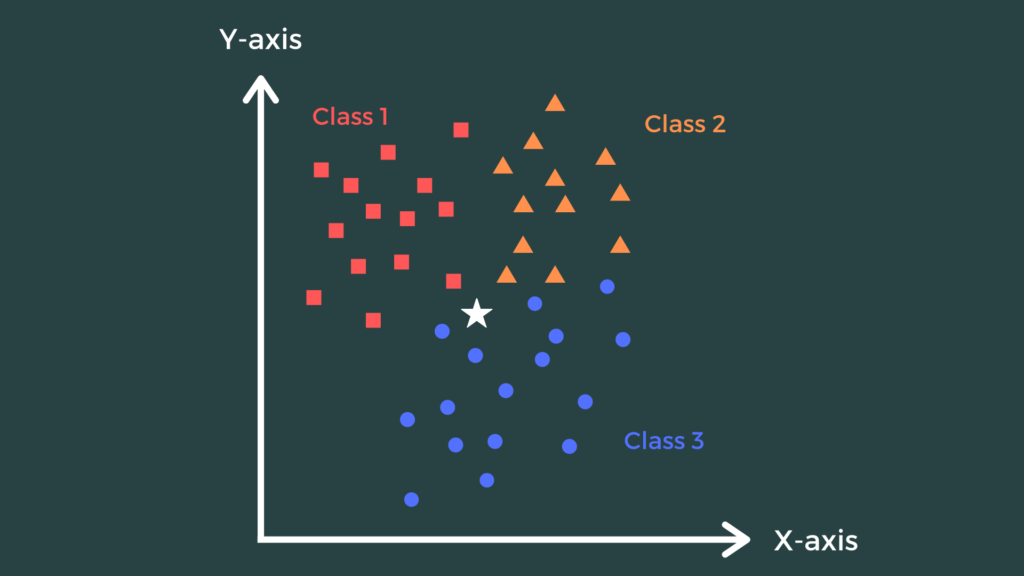
What is Nearest Neighbour Machine Learning?
Nearest Neighbour (K-NN) is a non-parametric, instance-based machine learning algorithm that predicts outcomes by analyzing the K most similar data points using distance calculations. It is widely used in machine learning for classification, regression, similarity matching, and pattern recognition tasks.
At Oodles, we build Nearest Neighbour models using Python and scikit-learn, ensuring accurate distance computation, scalable neighbor search, and seamless integration with data pipelines.
Why Choose Our Nearest Neighbour Services?
- ✓ Optimized K-NN implementations using scikit-learn and Python
- ✓ Advanced distance metrics for accurate similarity measurement
- ✓ Scalable neighbor search with KD-Tree, Ball Tree, and LSH
- ✓ Feature engineering, normalization, and dimensionality reduction
- ✓ Hyperparameter tuning to optimize K value and distance weighting
- ✓ Production-ready K-NN models for real-time and batch inference
Simple & Effective
Instance-based learning with no explicit training phase
Versatile
Supports classification, regression, and similarity search
Optimized
Efficient neighbor search using KD-Tree and Ball Tree
Accurate
High precision with proper feature scaling and K tuning
Our Nearest Neighbour Implementation Process
A structured approach used by Oodles to design, optimize, and deploy Nearest Neighbour machine learning models.
1
Problem Definition & Data Analysis: Define ML objectives, analyze feature distributions, and select appropriate distance metrics.
2
Feature Engineering & Normalization: Data cleaning, handling missing values, scaling features, and preparing data for distance-based learning.
3
Model Configuration & Optimization: Select optimal K value, distance metric, and neighbor search algorithm (KD-Tree or Ball Tree).
4
Training & Validation: Implement K-NN using scikit-learn, validate with accuracy, precision, recall, and F1-score.
5
Deployment & Monitoring: Deploy models using Flask or FastAPI, enable real-time inference, and monitor prediction quality.
Key Features & Capabilities
Distance Metrics
Euclidean, Manhattan, Minkowski, Hamming, Cosine, and custom similarity functions.
Algorithm Variants
K-NN classification, K-NN regression, weighted K-NN, and radius-based neighbor queries.
Fast Search Algorithms
KD-Tree, Ball Tree, and Locality-Sensitive Hashing (LSH) for high-dimensional data.
Hyperparameter Tuning
Grid search and cross-validation for optimal K and distance weighting.
Feature Engineering
Normalization, standardization, PCA, and feature selection for improved model accuracy.
Production Ready
Deployment via REST APIs using Flask / FastAPI, with scalable inference pipelines.
Nearest Neighbour Solutions & Use Cases
Versatile K-NN applications for classification, pattern recognition, recommendations, and anomaly detection.
Image & Pattern Recognition
Handwriting recognition, face detection, object classification, and medical image analysis.
Recommendation Systems
User-based and item-based collaborative filtering using similarity matching.
Anomaly Detection & Fraud Prevention
Outlier detection in financial transactions, network security, and quality monitoring.
Medical Diagnosis & Predictive Analysis
Disease classification, patient similarity analysis, and risk prediction using clinical data.
FAQs (Frequently Asked Questions)
K-NN is a non-parametric, instance-based machine learning algorithm used for classification and regression. It makes predictions by finding the K closest data points to a query point and determining the output based on the majority class (classification) or average value (regression) of those neighbours.
K-NN is widely used for recommendation systems, image recognition, pattern recognition, credit scoring, medical diagnosis, handwriting detection, video recognition, and anomaly detection. It excels in scenarios where data has natural clustering patterns and similarity-based predictions are needed.
We implement spatial data structures like KD-trees or Ball trees to reduce search complexity, apply dimensionality reduction techniques, use approximate nearest neighbour algorithms, implement parallel processing, and optimize distance calculations. These approaches significantly improve speed without sacrificing accuracy.
K-NN can be computationally expensive for large datasets, sensitive to irrelevant features and outliers, requires careful selection of K value, and struggles with imbalanced datasets. It also requires significant memory to store training data and can be affected by the curse of dimensionality in high-dimensional spaces.
We use cross-validation techniques to test different K values, typically starting with the square root of the number of data points. We analyze error rates for various K values using elbow method plots, consider odd K values for binary classification to avoid ties, and balance between overfitting (low K) and underfitting (high K).
Yes, with proper optimization. We implement efficient indexing structures, use approximate algorithms for real-time predictions, apply data pruning techniques, implement caching strategies, and leverage GPU acceleration when needed. These optimizations make K-NN suitable for production deployment with acceptable latency.
The choice depends on your data type and domain. Euclidean distance works well for continuous numerical data, Manhattan distance for high-dimensional spaces, Minkowski distance for generalized scenarios, Cosine similarity for text and high-dimensional data, and Hamming distance for categorical variables. We test multiple metrics to find the optimal one.
Ready to build K-NN solutions? Let's get in touch







We are ISO 9001:2015 Certified
Connect with us


Follow us