
K-Nearest Neighbor Algorithm for Data Science Excellence
Oodles specializes in building K-Nearest Neighbor (KNN) solutions for data science using a modern Python-based machine learning stack. Our implementations leverage scikit-learn, Python, NumPy, Pandas, and optimized distance metrics to deliver accurate and scalable classification, regression, similarity search, and anomaly detection systems. We design KNN pipelines optimized with KD-Tree and Ball Tree indexing, feature scaling, and hyperparameter tuning to ensure high accuracy and efficient performance on real-world datasets.
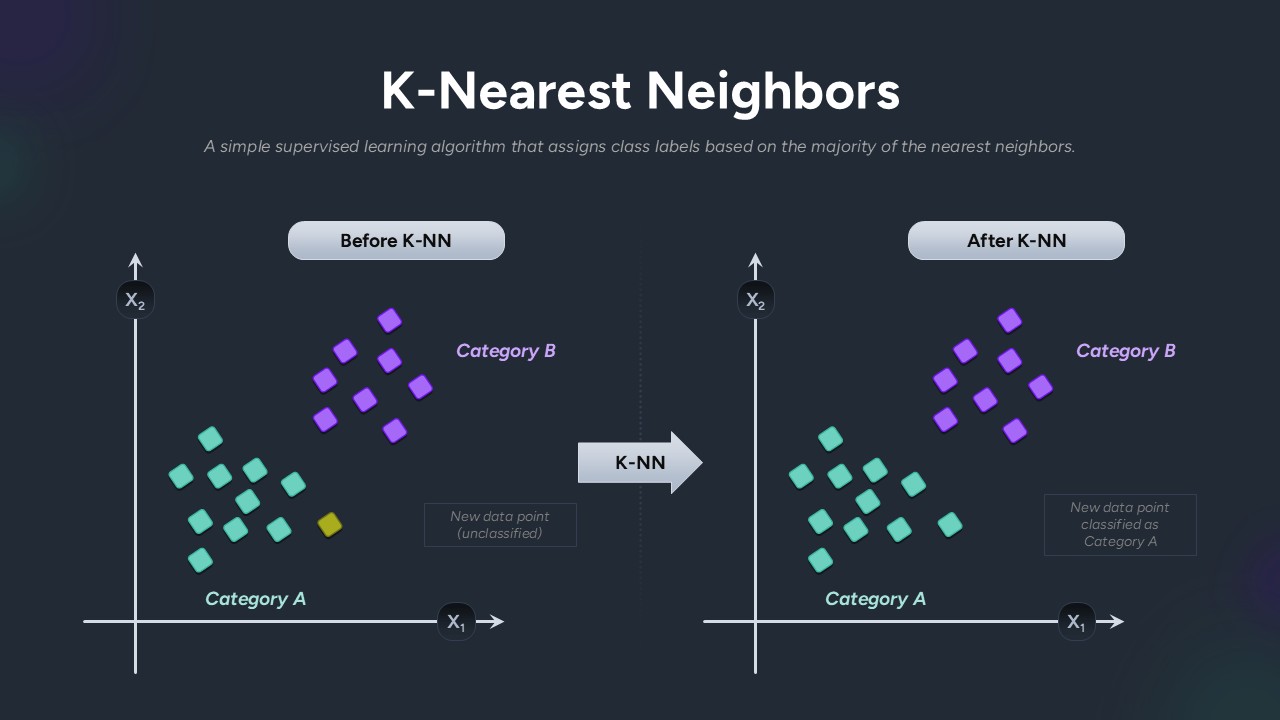
What is K-Nearest Neighbor in Data Science?
K-Nearest Neighbor (KNN) is a supervised machine learning algorithm that predicts outcomes by analyzing the K closest data points in a feature space using distance-based similarity measures. In data science, KNN is widely used for classification, regression, clustering support, recommendation systems, and pattern recognition.
At Oodles, we implement KNN models using industry-standard tools and best practices to ensure accuracy, scalability, and production readiness.
Why Choose Our K-Nearest Neighbor Services?
Optimized Distance Metrics
We implement Euclidean, Manhattan, Minkowski, cosine, and custom distance functions to improve similarity measurement accuracy.
Scalable KNN Architectures
Efficient neighbor search using KD-Tree, Ball Tree, and approximate nearest neighbor techniques for large and high-dimensional datasets.
Advanced Feature Engineering
Feature normalization, standardization, dimensionality reduction (PCA), and feature selection to enhance KNN performance.
Hyperparameter Tuning
K-value optimization using grid search, cross-validation, and performance metrics to maximize model accuracy.
Production-Ready KNN Models
Deployment-ready pipelines with batch inference, real-time prediction APIs, and monitoring.
Expert Data Science Guidance
Strategic consulting from Oodles on KNN suitability, optimization, and integration within broader ML workflows.
Real-World Data Science Use Cases
Image & Pattern Recognition
Handwriting recognition, image similarity, face recognition, and object classification using KNN-based similarity learning.
Recommendation Systems
User-based and item-based collaborative filtering for personalized product and content recommendations.
Medical Diagnosis & Healthcare Analytics
Disease classification, patient similarity analysis, and clinical decision support systems.
Anomaly Detection & Fraud Analysis
Outlier detection in financial transactions, network traffic, and quality assurance systems.
Credit Scoring & Risk Modeling
Customer risk profiling, creditworthiness prediction, and loan default classification.
Customer Segmentation & Behavioral Analysis
Grouping customers based on similarity in behavior, demographics, and transaction patterns.
FAQs (Frequently Asked Questions)
K-NN is a supervised learning algorithm that classifies data points based on their proximity to K nearest neighbors. It calculates distances (Euclidean, Manhattan, or Minkowski) between points, identifies K closest neighbors, and determines classification by majority vote or regression by averaging neighbor values.
K-NN is simple to implement, requires no training phase, adapts to new data easily, works well with multi-class problems, and is effective for non-linear data patterns. It's intuitive, making it excellent for beginners while remaining powerful for complex classification and regression tasks.
We address the curse of dimensionality through feature selection, dimensionality reduction (PCA, t-SNE), feature scaling, and using appropriate distance metrics. We also implement spatial data structures like KD-trees and Ball trees to optimize performance in high-dimensional spaces.
We primarily use scikit-learn's KNeighborsClassifier and KNeighborsRegressor, along with NumPy for numerical operations, Pandas for data manipulation, and Matplotlib/Seaborn for visualization. For large-scale applications, we leverage libraries like FAISS for efficient similarity search.
We use cross-validation to test multiple K values, plot error rates using the elbow method, and analyze model performance metrics. Generally, we start with K = sqrt(n) where n is the number of data points, then optimize based on validation accuracy, considering odd values to avoid ties in binary classification.
K-NN struggles with imbalanced data as majority classes dominate predictions. We address this through resampling techniques (SMOTE, undersampling), weighted K-NN where closer neighbors have more influence, adjusting decision thresholds, and using ensemble methods to balance class representation effectively.
K-NN has high prediction time complexity O(n*d) for n samples and d dimensions, requires significant memory to store training data, and becomes slow with large datasets. We optimize using indexing structures, approximate methods, parallel computing, and GPU acceleration for real-time applications.
Ready to implement KNN algorithms for your data science projects? Let's talk







We are ISO 9001:2015 Certified
Connect with us


Follow us